
Introduction
Open-cell foam insulation is becoming a popular choice for homeowners seeking energy efficiency and comfort. If you’re in the Calgary area, White Knight Contracting has been serving the community since 2011, offering expert spray foam services and more. Understanding the difference between open-cell and closed-cell foam can help you make a smart investment in your property.
Table of Contents
- History of Foam Insulation
- Open-Cell Foam vs. Closed-Cell Foam: What’s the Difference?
- Foam Cell Structure and Foam Density Explained
- Current Trends in Spray Foam Insulation
- Challenges of Choosing Open-Cell or Closed-Cell Foam
- Future Prospects of Foam Insulation
- Real-World Scenarios: Open-Cell or Closed-Cell Foam?
- What to Expect When Upgrading Your Insulation
- Interesting FAQ
- Contact & Location
History of Foam Insulation
Foam insulation made its debut in the 1940s. At first, closed-cell foam dominated the market, prized for its rigid structure and water resistance. Open-cell foam came onto the scene later and quickly gained popularity for its lightweight design and soundproofing qualities. As the need for eco-friendly and efficient buildings grew, spray foam options like open-cell and closed-cell foam became essential in modern construction.
Open-Cell Foam vs. Closed-Cell Foam: What’s the Difference?
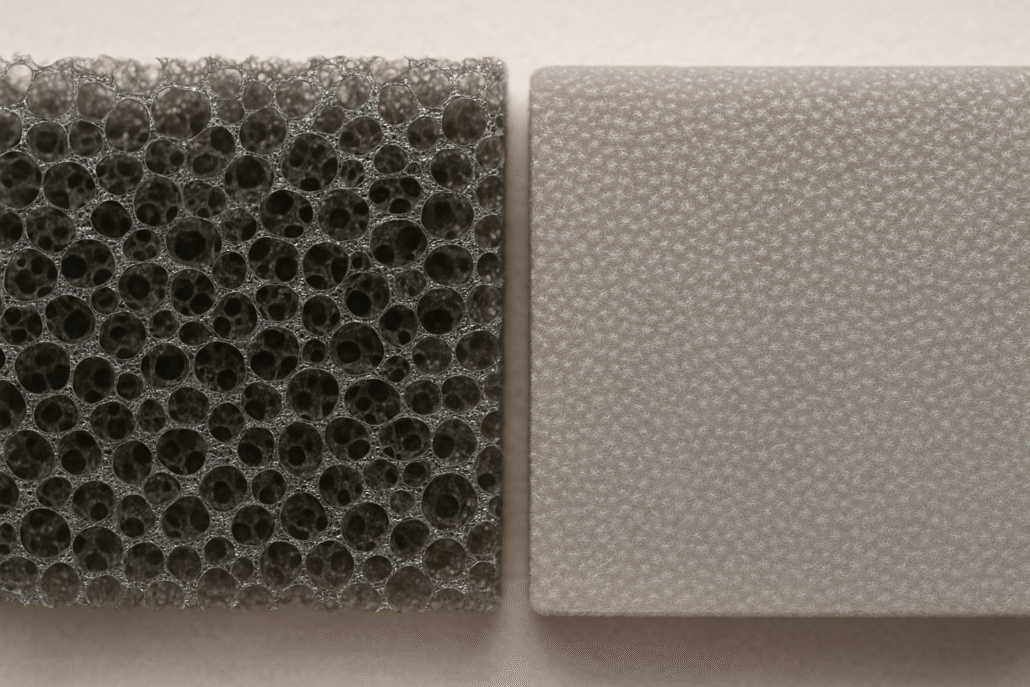
The main difference lies in the foam cell structure. Open-cell foam uses interconnected cells, creating a soft and spongy texture. Closed-cell foam uses cells that are completely sealed, resulting in a denser and more rigid structure.
- Open-cell foam: Great for sound control and flexibility, with a lower foam density—usually about 0.5 pounds per cubic foot.
- Closed-cell foam: Offers stronger moisture resistance, higher R-value, and greater foam density, sometimes exceeding 2 pounds per cubic foot.
Both foam types can be installed as spray foam insulation, but the right choice depends on your priorities: energy savings, soundproofing, strength, or moisture control.
Foam Cell Structure and Foam Density Explained
Foam cell structure describes whether the tiny bubbles (cells) inside the foam are open or closed. In open-cell foam, air easily passes through, making it excellent for interior walls where air and sound control are top priorities. Closed-cell foam’s sealed cells make it waterproof and highly insulative.
Foam density impacts everything from strength to insulation performance. Higher foam density, as found in closed-cell foam, boosts thermal performance but can make the product heavier and more expensive. Open-cell foam has lower density and is easier to trim or cut after installation.
Current Trends in Spray Foam Insulation
Homeowners and builders are increasingly choosing open-cell foam for attic and wall applications because it’s cost-effective and environmentally friendly. Builders also love closed-cell foam for areas with moisture concerns or where a vapor barrier is needed. Today’s trends also include eco-friendly spray foam made with fewer chemicals, providing better indoor air quality than traditional insulation products.
Industry reports predict continued growth for spray foam insulation due to stricter energy codes and homeowners’ demand for better energy savings. According to Allied Market Research, the global spray foam insulation market could reach USD 3.9 billion by 2031.
Challenges of Choosing Open-Cell or Closed-Cell Foam
Selecting between open-cell foam and closed-cell foam brings some challenges. Open-cell foam can absorb moisture, making it unsuitable for basements or exterior walls without the right vapor barrier. Closed-cell foam is pricier up front and can sometimes make walls too stiff or hard to modify later on.
- Moisture problems: Open-cell isn’t right for all areas—closed-cell may be a must for wet or flood-prone spaces.
- Budget: Open-cell saves money, but closed-cell foam can deliver better energy savings over time.
- Installation: Both types need professional handling to avoid gaps or over-spraying, but open-cell’s softer texture makes it easier to fit around obstacles.
Future Prospects of Foam Insulation
Looking forward, foam insulation innovation will focus on greener manufacturing, recycled content, and improving foam cell structure for even better efficiency. Smart home technologies—monitoring insulation performance through sensors—may also emerge. As energy prices keep rising, both open-cell and closed-cell foam will play a crucial role in construction and remodeling projects.
Real-World Scenarios: Open-Cell or Closed-Cell Foam?
Imagine you’re finishing a basement in Calgary where moisture is a concern—closed-cell foam’s higher density and sealed foam cell structure provide reliable vapor and moisture barriers. For an attic remodel, open-cell foam might be best, offering lower cost and outstanding sound dampening.
A local small business recently upgraded its historic office building using open-cell foam in walls for improved acoustics. In contrast, a lakeside cottage owner opted for closed-cell foam below-grade to keep moisture at bay.
What to Expect When Upgrading Your Insulation
Upgrading to spray foam insulation usually follows a simple process:
- Inspection: A contractor evaluates the building and recommends open-cell foam or closed-cell foam based on needs and budget.
- Preparation: Surfaces are cleaned and masked off.
- Application: Foam is sprayed and allowed to expand in the space.
- Finishing: Excess foam is trimmed; drywall or finishing materials are applied.
Step-by-step guidance and professional support make for a stress-free project—especially if you choose a contractor who can handle extras like siding without sub-trades.
Interesting FAQ
For those wanting to learn more about attic insulation, DAP’s blog offers a detailed DIY guide on attic insulation using spray foam.
- Q: Is open-cell foam safe for homes with allergies?
A: Yes. Open-cell foam doesn’t contain dust or loose fibers like some older insulations, making it a good choice for allergy-sensitive spaces. - Q: How does foam density affect energy bills?
A: Higher foam density in closed-cell foam delivers stronger insulation, often resulting in lower energy costs because it reduces air leakage more effectively. - Q: What is the lifespan of spray foam insulation?
A: When professionally installed, both open-cell foam and closed-cell foam can last for decades—often 20 years or more without serious loss of performance. - Q: Can one contractor handle my insulation and exterior work?
A: If you work with a team like White Knight Contracting, you can tackle insulation and siding upgrades in one job, saving time and hassle.
Contact & Location
Ready to discuss open-cell foam or closed-cell foam? Here’s where to find White Knight Contracting in Calgary:

